ART² 3D View launches: clearer follow-up monitoring for clear aligner treatment
YIMEIQI’s expression analysis system adds a 3D view — mesh comparison, model overlay and quantitative expression-rate analysis — to make follow-up monitoring clearer and faster.
2 April 20265 min readYIMEIQI Engineering Team
Follow-up monitoring is one of the factors that decides whether a clear aligner case finishes on plan. Most progress reports available today are presented as flat 2D pages, which makes it hard for a clinician to read tooth movement dynamically — sagittally, transversely and vertically at the same time. Comparing progress usually means opening the 3D animation plan and checking it by eye, which is slow. And those 2D reports do little to help a patient understand what is happening, so compliance conversations stall.
What the 3D View adds
To address these pain points, the YIMEIQI Alignment Ratio Analysis System — ART², short for Anytime Re-Treatment achievement rate table — has been upgraded with 3D visualization. The aim is a follow-up tool that is efficient at the chairside while also giving patients a clear picture of their own progress, which supports compliance.
Mesh comparison — animated mesh tools quantify how far each tooth has moved at a follow-up visit relative to its initial position, and set that against the remaining planned stages to support progress evaluation.
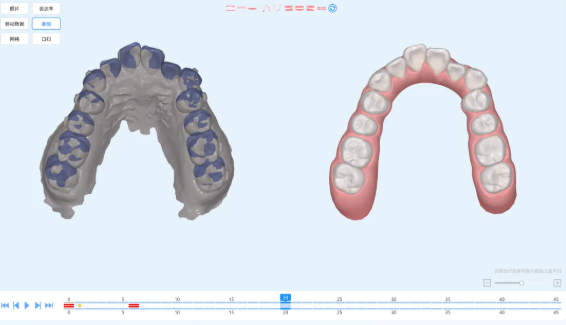
Model overlay — the current model is overlaid on the initial model in 3D, so progress across the whole treatment cycle is shown visually rather than described.
Photo reference — follow-up photos can be viewed alongside the model, supporting multi-angle analysis and a more intuitive presentation of outcomes.
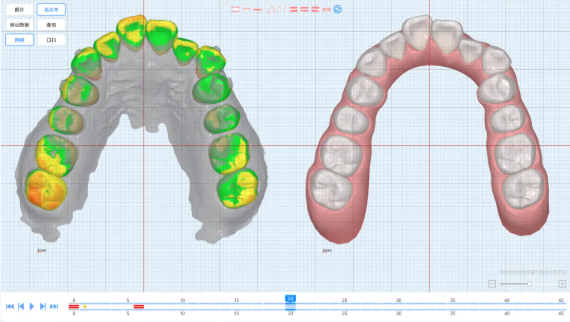
Qualitative analysis — final target positions are checked with a color-coded map, where each color corresponds to a different expression outcome, helping clinicians spot the teeth and regions that need attention.
Quantitative comparison — tooth movement data and expression-rate figures are presented numerically, giving a basis for clinical decisions instead of an estimate.
Screens from the ART² 3D View interface.
Why it matters in practice
The 3D View is designed to shorten the time a clinician spends assessing a follow-up visit, and to give a more precise read of a patient’s orthodontic progress. Three things change at the chairside:
Results are generated within about a minute, reducing the time a patient spends in the follow-up appointment.
Overlapping tooth movement is shown with color coding, reducing subjective visual bias.
Movement data and expression rates are quantified, removing the error that comes from estimating by eye.
Progress is presented as 3D model comparisons, making the follow-up conversation easier to follow.
Taken together, these changes move follow-up monitoring from a manual, 2D exercise toward something faster and more evidence-based — without taking the clinician out of the loop.
A note on interpretation
ART² is an analysis aid. Expression-rate figures and overlays support, but do not replace, the treating clinician’s judgement on whether a case is tracking to plan and what to do next.
On 15 July 2026, Meiqi Technology opened its Shaoxing Intelligent Manufacturing Center, raising clear aligner capacity and refreshing its initial-wear gift boxes.
At the 10th Everything Grows Conference in Hangzhou, Dr. Ning Nan was recognized in the AI + Healthcare category for research and entrepreneurial achievement.